
[This review contains spoilers for Pluribus Season 1, Episode 6, “HDP”]
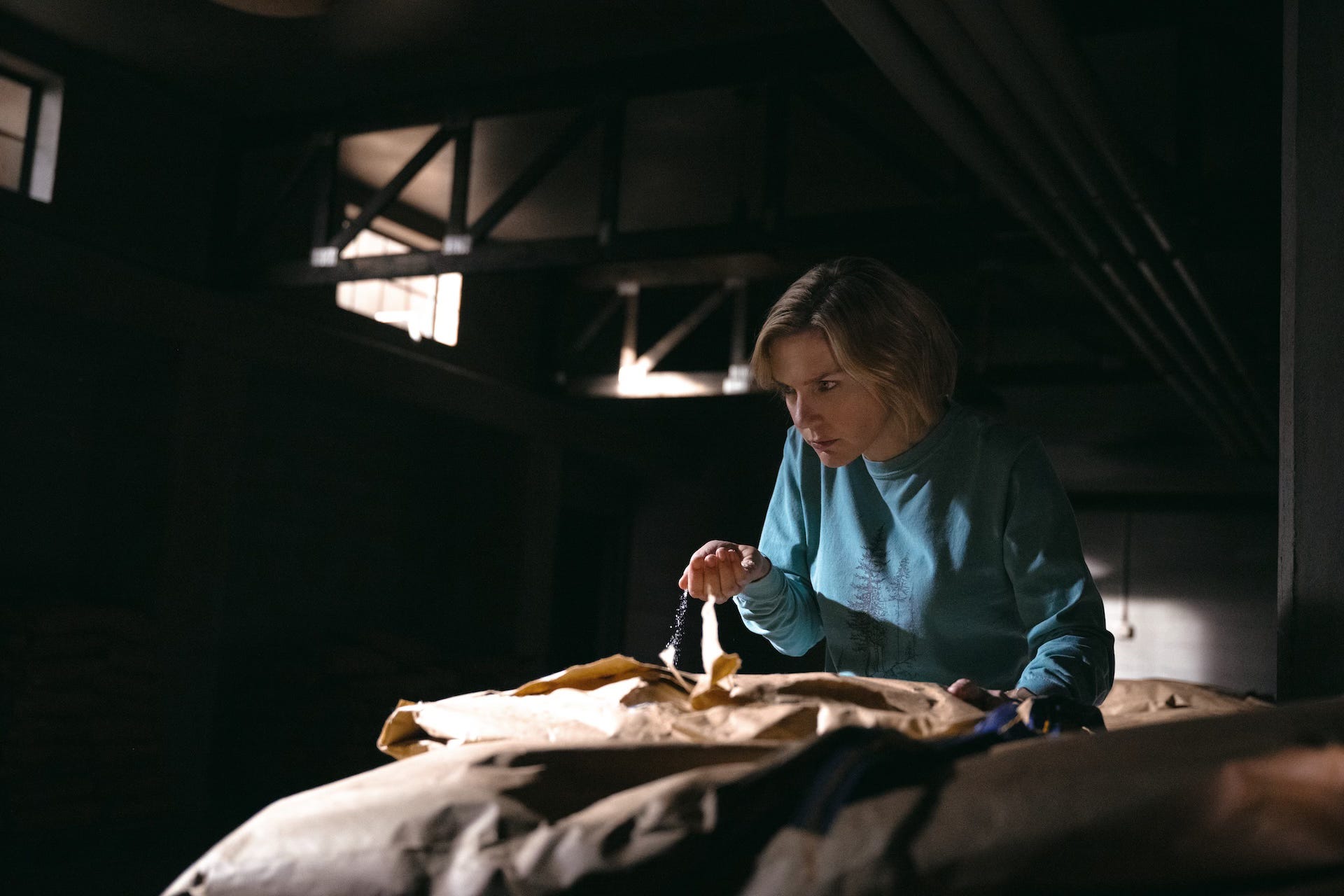
We all need other people, some more literally than others. At the beginning of “HDP,” Carol discovers that the hive’s food source is…people! That’s right, they’re grinding up parts of cadavers and putting them into their food. So they’re monsters! We’re going back to classic sci-fi like Soylent Green! Except that’s not the show Vince Gilligan and company have really been making, and every time it looks like they’re about to travel down a familiar path, they veer off into a new direction. “HDP” is really an episode about loneliness and how much we need other people. Carol’s world of physical isolation may be what we immediately think of when it comes to loneliness, but as the episode expands, we can see how much dependence on others matters, whether it’s Koumba’s playboy lifestyle or simply the need to feed on dead humans as sustenance. Everybody needs somebody.
The clever move at the outset isn’t the discovery of the bodies but switching over to Koumba’s perspective in what appears to be a scene so lively that the show may be taking us back before the joining. But no, it’s just Koumba using real people to live out a fantasy like he’s on the holodeck in Star Trek. And yet this artificial crush of people speaks to how Koumba is as lonely as Carol, even if his isolation looks different. He can only orchestrate the imitation of life, and it will always let him down at least a little bit, like when he reminds one of his players to “stay in character!” He then retires to fooling around with almost any woman he wants, in a further emphasis of how badly he needs this playboy fantasy to avoid his feeling of isolation. It’s no mistake that the pictures on the wall are of himself and no one else. Sure, he’s got a massive ego, but that doesn’t mean he’s much better off than Carol.
Carol decides to come to Koumba personally to tell him about the body parts, but he already knows. Her entire experience in Vegas is to deflate her confidence and make her feel like a loser, so I suppose some things never change in the “trillion-dollar light-up ashtray.” Koumba not only knows about the body parts, but he also has a useful informational video starring John Cena. The individual, once known as the 17-time wrestling world champion, informs Carol that because the hive refuses to take life even through agricultural means, they can only eat what’s been discarded. Like an apple that’s fallen to the ground or processed food sitting in warehouses, they must also subsist on 8-12% of HDP, or “human-derived protein,” from people who died of natural causes. They don’t feed this to the individuals, and they would prefer not to eat human remains if it could be avoided.
Koumba has a few more surprises for Carol, whose investigative skills are no match for Koumba chatting with the other individuals and the hive. She learns that although the hive wanted to join with the individuals and studied how to do so, they only recently learned that joining with the individuals is impossible because it would require their stem cells. Without the consent of the individuals, the hive can’t extract the cells, and so the individuals will remain unconnected if they wish. Furthermore, the hive has a much bigger problem because even with subsisting on HDP, most of the world’s population with starve to death in the next ten years. This is a major change-up to Carol’s mission. Whereas before she wanted to avoid being absorbed into the hive, now her mission to save the world means ensuring that the hive doesn’t starve because it refuses to harvest wheat or pick an apple.
But more than what Carol learns about the hive is how much “HDP” continues to stress how lonely she is. It’s abundantly clear that Helen was the only person Carol was close to, and that Carol was never a social butterfly. You can see the heartbreak across Carol’s face when Koumba tells her he’s still chatting with eleven of the other individuals on a biweekly Zoom call. Carol Sturka may now be the loneliest person in the world, as not only do the individuals actively exclude her (“we took a vote,” says Koumba), but also the hive “needs some space.” But putting Carol and Koumba together provides a stark look at how loneliness manifests itself. Carol’s loneliness is clear, but it’s tough to argue that Koumba is emotionally nourished by keeping in touch with the individuals and the hive. The only thing keeping him afloat seems to be how blissfully unaware he is of solitude, choosing to lose himself in fantasy.
There’s probably only one person left on Earth who fully understands Carol. The clock rewinds three days, and we return to Manousos Oviedo in Paraguay. He gets Carol’s message, and it’s clear how much it means to him. What’s fascinating in Manousos’ story is that despite his extreme isolation, he’s in a similar boat to the hive where he has curtailed his diet based on his beliefs. However, once he realizes that Carol is out there and shares his disdain for the hive, he decides to finally leave his storage facility fortress and make his way towards Albuquerque. On his way out the door, he has a brief interaction with what was formerly his mother. “You’re not my mother,” he tells the drone. “My mother was a bitch.” Yes, I think if they can overcome the language barrier, Carol and Manuosos might get along famously.
Stray observations:
I love the Cena cameo so much. I know he’s a culturally ubiquitous figure, but he’s a great comic presence because he’s a hulking man who can deliver the persona of a 1950s TV dad. He’s very much the gentle giant, so who better to deliver the news that the hive is eating human cadavers? Furthermore, I don’t know if it was intentional, but Cena is also a fun drop-in when you consider that the first season of Peacemaker was operating in similar thematic and narrative territory.
It was not “unanimous” to not include Carol in discussions, so she’s not off-putting to every single individual (and the fact that Koumba thought to mention this makes me think he wished to include her). More importantly, Carol only inviting English speakers to her original summit does speak to her American-centric values, which is an important point not to say that she’s xenophobic, but that, like most Americans, does not consider the English-speaking world. The inclusion of Manuosos, a Spanish-speaker from Paraguay, feels like a way of further stressing this point about Carol’s blind spots.
As much as Koumba has surrounded himself with members of the hive, his fantasy shows the shortcomings of individual imagination just as much as Carol believed she had discovered vital information independent of anyone else. I’m not surprised that Gilligan, who clearly values the collaboration of writers’ rooms, somewhat rejects the notion that individuals have boundless imaginations. Koumba can only devise a James Bond riff, and Carol would have reached her conclusions faster if she weren’t so personally off-putting.
I’m curious about what’s happening at frequency 8.613.0, but I suppose that’s another mystery for another day.
Pluribus airs on Fridays on Apple TV. Matt Goldberg is a critic who lives and works in Atlanta. If you enjoyed this review, check out his newsletter, Commentary Track.