
[This review contains spoilers for Pluribus Season 1, Episode 7, “The Gap”]
Pluribus enjoys its central paradox. We know that humans are social creatures, but we also prize our individuality. If you erase all individuality, you limit what humans are capable of and why our actions have weight. Conversely, rugged individuality has its limits. No man is an island, and watching the show’s individuals try to find their way outside the hive’s control has yielded, shall we say, mixed results. We get a clear picture of that in the season’s seventh episode, “The Gap,” which follows two journeys: one for Carol, who decides she’ll live a variation of Koumba’s hedonistic lifestyle where the hive caters to her whims, and another for Manousos, who is so dead-set against any hive assistance that he’ll endanger his life to reach Carol.
The first half of the episode is Carol deciding to lean in towards having the hive do her bidding. If she’s going to be alone, she should at least be comfortable. She decides to be particularly snobby when a Gatorade she orders is not ice-cold. “Do better next time,” she says in her voicemail to the hive like an Amazon customer leaving three stars on a review. In 12 days, Carol has adjusted to, “This is how the world is now,” and we can see the parallels in how we expect not only comfort but also expect it quickly and perfectly. Furthermore, with the hive purposely staying out of Carol’s presence, there’s a clear metaphor about unseen human labor. Vast human resources are summoned to get a single bottle of fruit punch Gatorade (admittedly, the best Gatorade) to a person in the middle of nowhere, and Carol can only note that the temperature is wrong because, of course, there are going to be trade-offs when you use a drone to cart a single container an indeterminate number of miles. Comfort breeds a certain kind of callousness, and for Carol, that callousness is necessary to endure her isolation.
I suppose this is the best place to highlight the socioeconomic critique in the episode where Pluribus illustrates the gulf between American comforts and hardships elsewhere in the world. It’s true that Manousos now has the world at his fingertips with the hive happily offering to assist him in any endeavor. But where is his golf course? Where is his Rolls-Royce? Carol easily picks these things up in her suburb, and it’s not an accident that while she is humming various pop and rock hits, the music that gets played during her malaise is “Stars and Stripes Forever.” Carol has access to any thing, but she’s stuck in a state of severe isolation. The American condition is one of expected plenty, and yet Americans are typically miserable with the technological advances of the 21st century, only deepening our sense of isolation and alienation. All the comforts in the world can’t make up for a loneliness so deep that later in the episode Carol is willing to get a face full of fireworks if it means stopping the pain.
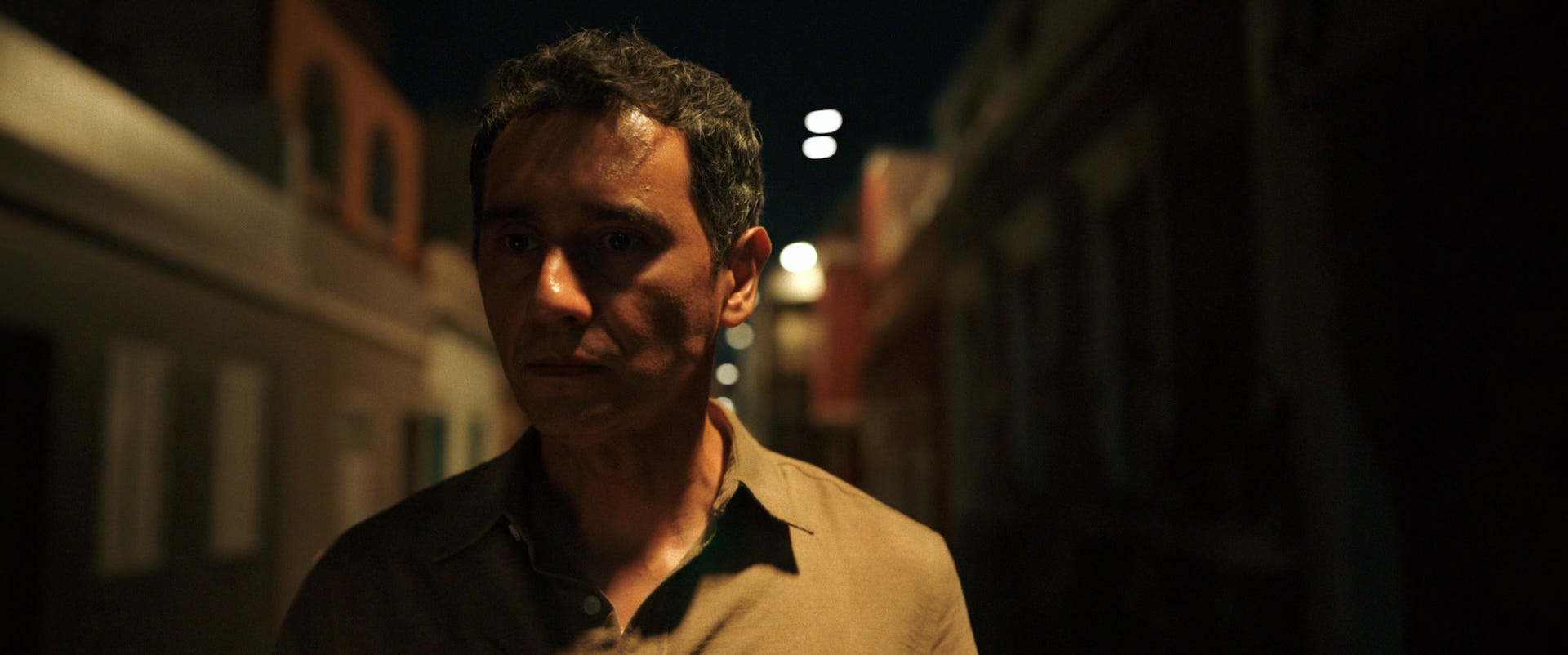
For Manousos, pain is the name of the game. On the one hand, there’s something oddly heroic about a guy who is going to make a roughly 5,000-mile journey by himself without any assistance from anyone. And yet, as the journey continues, we further see Manousos as so stubborn that he’ll endanger his life in this quest. As great as it is to see him practicing another language, trekking through the wilderness, and drinking rainwater out of old cans, consider the extent of his rejection of assistance. It’s one thing to say he won’t take a flight to New Mexico, but it’s another to refuse a weather report. And true—we don’t know the weather unless people are working together to read and convey meteorological information. Manousos says (in a line that I feel will be increasingly deployed against AI), “Nothing on this planet is yours. You cannot give me anything because all that you have is stolen.” But is information about terrain and weather “stolen” in the same way that a bottle of Gatorade gets airlifted in for one person?
It’s a fine line between heroism and foolishness, and one could argue that Manousos veers a little too far towards the latter when he makes his way through the spiny trees of death and then has to cauterize the wounds. He’s correct that people weren’t meant to live as part of the hive or catered to by the hive, but we probably also weren’t meant to trek through jungles alone lest we be somewhat impaled. Life is undoubtedly harder in Manousos’ region of the world, but as an individual, Manousos is playing on the hardest difficulty. We can’t control everything. As much enmity as Manousos feels towards the hive, he’s also getting in his own way of stopping them. But that’s incredibly human: how much do our egos get in the way of larger goals? The priority is reaching Carol to save the world, but Manousos’ actions speak towards someone who cannot accept any interference from the hive. I don’t think Vince Gilligan and his writers are making a statement that life is harder in South America because that’s what its inhabitants choose. It’s harder because they don’t engage in the same kind of overconsumption as we do in the United States. Manousos is arguably making it harder as a show of defiance, but it would still be difficult under normal circumstances. AI is the closest handhold to “what’s stolen,” but you could take it much further back to colonialism. The world has changed since The Joining, but Pluribus is acutely aware of how it operated before the hive’s emergence, and that the history of these places can’t be erased even with quickly available comforts.
For an episode called “The Gap,” it eventually brings Carol and Manousos to the same thematic place of deep pain. We don’t know where Manousos is, but he’s presumably been airlifted to a hospital to receive the finest care the hive can provide, and he will presumably rip out his IVs the second he regains consciousness. As for Carol, 48 days since The Joining and spending almost all of that time in isolation, she asks the hive to come back. There are more hazards in the world than spiky trees, and as many comforts as you can consume, you can’t give yourself a hug.
Stray observations:
Pluribus excels in finding the humor in its quietest moments. There are plenty of funny shows that you can quote all day, but Pluribus is funny in how odd it can get, like Carol singing the song from Caddyshack as she drives around a golf course and then spots a bison.
When we think of survivalists in America, that still means people who live a fairly rooted existence. Even in the post-apocalyptic visions, it usually becomes a fight for resources and building compounds. However, Manousos’ survivalism feels individualistic without being defensive. He’s not worried about attacks, and it’s telling that he’s injured not by fauna but by flora. As many precautions as you take, you can still slip on a rock.
Speaking of American individualism, there are people in America who really think that they have accomplished everything on their own and have never needed another person. This is, of course, ridiculous. Manousos’ journey is what real individualism would look like, and despite the beauty of the South American landscape, the day-to-day trekking is not pleasant!
There are many damning portraits of American life, and one that’s comprised of fireworks, golf, and loneliness deserves to enter that gallery.
Pluribus airs on Fridays on Apple TV. Matt Goldberg is a critic who lives and works in Atlanta. If you enjoyed this review, check out his newsletter, Commentary Track.
I wonder if the “Others” philosophy of “No Harm” also applies to the Earth. They seem to have no qualms using lots of fuel with all these plane trips with minimal people inside as well as providing tons of automotive gas for Carol and the others, but would they refuse to drill for more oil and refuse to distill more gas as it would affect the earth as well as all life. Carol and Koumba are just living it up with driving Rolls Royce cars and Lamborghinis, but for how long?
Probably this “10 years” also applies to all resources, not just food. Eventually they are going to shut down as many sources of energy production because of this same harm it could cause and to also conserve resources.
Love this. Thanks for your reflections!
Here’s my thoughts:
https://open.substack.com/pub/saraeson/p/pluribus-episode-07-the-gap?r=1t83gn&utm_campaign=post&utm_medium=web&showWelcomeOnShare=false