
[This review contains spoilers for Pluribus Season 1, Episode 8, “Charm Offensive”]
In America, we have a consumerist culture. The things we buy become reflections of our identity, and when we buy things that other people buy, we feel a sense of community with those people. In crass, capitalistic terms, that’s being a fan. There may be a shared ethos, but the actions come from what we possess existing as a means of expression. We made a choice based on our interests, and those choices reflect our individuality as well as commonality. During the Cold War, it was easy for America to paint Communists as nothing more than drones, people wearing the same clothes and shopping at the same stores, deprived of their individuality by the state. In the world of Pluribus, what does it mean to be an individual when everything is essentially free and almost no one else is making choices?
For Manousos, the equation remains simple. As expected, he awakens in a hospital with the hive working to save his life, and he busts out as soon as he has a modicum of consciousness. More importantly, before resuming his journey, he asks the hive how much he owes, and while at first they insist that his care is free, he demands that he pay what he would have owed before The Joining. He then promptly writes them an I.O.U. for roughly $8,000 as well as an ambulance to make his way to New Mexico.
Taking the ambulance is a key moment because it signals the limits of individual action. If he hadn’t been impaled on a tree and airlifted to a hospital by the hive, what was the plan after hacking his way through the jungle? Was he going to walk the rest of the way? And why is that no longer the plan? This isn’t to say that Manousos is a hypocrite, but rather to highlight the limits of fierce individualism. In the previous episode, Manousos told the hive that nothing belonged to them because it had all been stolen, but here we see that he’s also driven by wanting to owe them nothing. And yet to be human is to owe something to others. To pretend we’ve made everything on our own steam is the height of narcissism, and as Carol learns in this episode, we do need other people, even if they happen to be a giant hive mind.
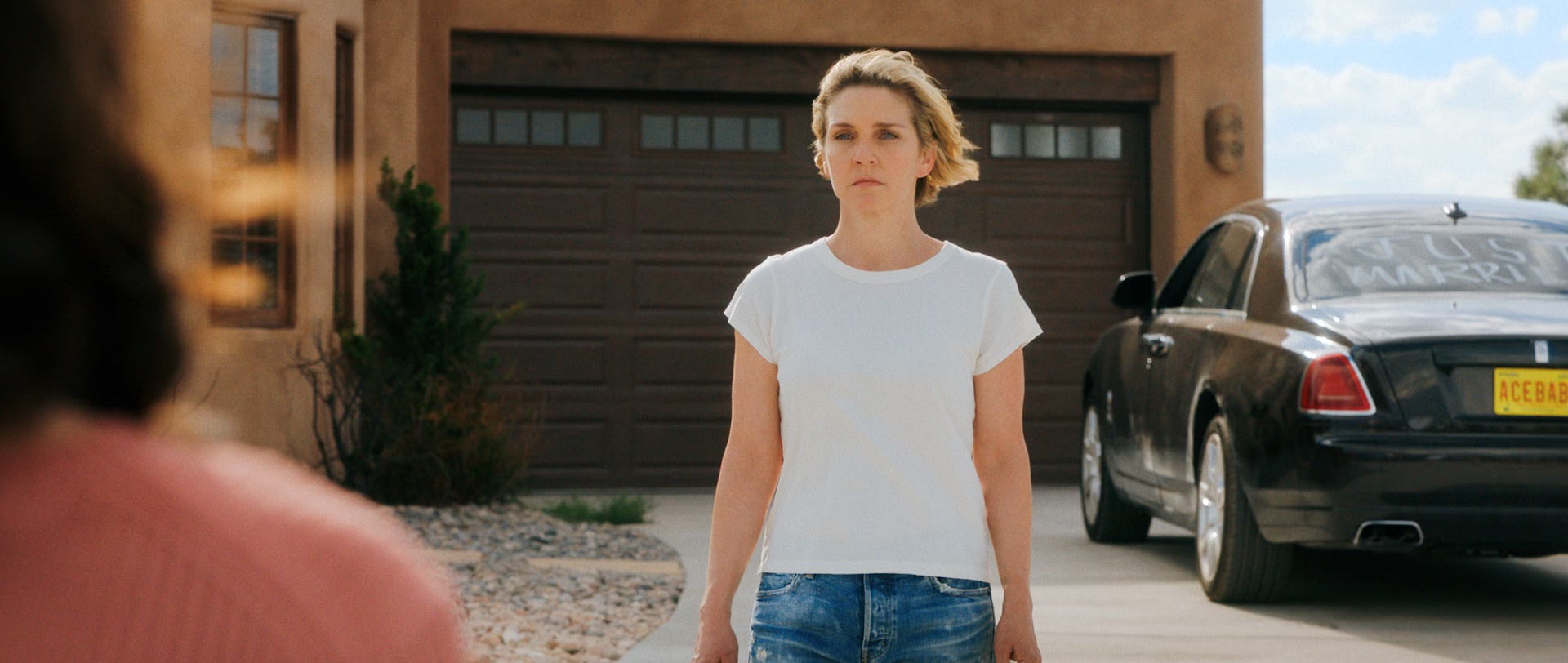
Carol’s new tactic (as the episode title indicates) is to play nice. Being isolated in Albuquerque left Carol in such a state of despair that she needed them back, not simply to populate the city, but specifically the company of Zosia. In these scenes, Carol attempts to form some kind of intimacy, not pretending that the hive are individuals in a play like Koumba, but also trying to see how much she can connect with Zosia while learning more about the hive. For Carol, we can see the rejuvenation as researching the hive gives her a project, but she also begins to open up and connect with Zosia (and thus, the entire world).
There are some plot notes here for those who want to go down that route (the hive communicates through the body’s natural electric charge; they’re somewhat omniscient but there are things they don’t know like Carol’s affection for trains), but the strength of the episode is watching Carol attempt to stay on a tightrope between learning about the hive and staying guarded, which she knows she can’t do. So they end up playing spit and croquet. She shares how much she loves the sound of a train whistle. She’s no longer “fighting” in the traditional sense of trying to trick the hive or refuse them, but there is an exchange happening where Carol is giving up her privacy to gain a little intimacy, such as it is.
We see this awkward dance clearly when it comes time to sleep in the gym. There is the subtle acknowledgment that, were you to take communism to its natural conclusion, everyone would sleep in the same room to conserve resources. Of course, without the hive mind, this would be impossible, as the threat of attack or even loud snoring would nix a good night’s rest. In the world of Pluribus, it can happen, but it highlights the odd tension where everyone is sleeping in a gym, but Carol just wants to sleep next to Zosia. It’s a reminder of how we’re part of the world, but what we crave is not the whole thing; just our little slice of it and the people within it.
But the hurdle with the hive isn’t intimacy; it’s how far they’re willing to go to make Carol “happy,” without understanding that Carol doesn’t want to bend the entire world to fulfilling her desires. It may be a bit much to say that the world is a zero-sum game, but there are trade-offs, and if you want to recreate a vivid piece of nostalgia for Carol, that will involve vast resources to reconstruct the diner and fly a person all the way from Miami to play waitress. But as we saw with the loss of Helen, the things we have take on importance because we can lose them. Does Helen live on in the hive mind? Sure, but not really. She’s gone, and so is the diner, and so is the past where Carol embarked on her writing career. The paradox of having everything means you truly have nothing.
The diner recreation pushes Carol to her limit, and she confronts Zosia about the limitations of their odd relationship. She wants to talk to Zosia, but “all the brains in the world, and you can’t navigate a fucking pronoun.” The scene also has some playful bits of dialogue that reference earlier points in the episode, like Carol asking for some honesty by saying, “cards on the table,” and then referring to her relationship with the hive as a “train wreck.” But this scene also forms the crux of the problem, where Carol, should she fall for Zosia/the hive, knows that they’re going to die off because they can’t even pick an apple off a tree. What would it mean to love this weird new organism that is both everyone and yet a bit of this individual known as “Zosia?” By trying to break down some barriers, Carol has also opened herself up, and through that exchange, acts on her desire to sleep with Zosia.
It’s an important moment because this sexual intercourse isn’t like Koumba asking to sleep with anyone in the world. There’s a real connection here, but also a bit of sacrifice, as Carol has let her guard down and allowed herself to fall for this strange being. But by the same token, this is not the hive merely catering to Carol’s latest whims. Carol is pushing Zosia to access more of her individuality by asking about her past and her favorite food. When Zosia shares the memory of getting mango ice cream as a child, that’s clearly a treasured moment, something precious that is being shared, but also belonged to Zosia regardless of the hive’s ability to access such a memory. What we own also allows us to decide on what we choose to share.
Which is a good point to return us to the world’s most isolated man, Manousos. As he struggles to take care of his wound, he is now close to reaching Carol, and will likely be a little surprised that the woman who said she wanted to save the world from the hive is now cohabitating with them. We’ll see if he can still buy her pitch when the show wraps up its first season next week.
Stray observations:
American viewers seeing a hospital stay in Panama only costs around $8,000: “I gotta move to Panama or any other country that has figured out healthcare.”
The “turning off” of the city to remove light pollution was a neat effect, not because it was overly flashy or complicated, but simply because it was a cool visual.
For most of the season, we’ve seen Carol at war with the hive, but the show is more compelling when it’s Carol at war with herself. We get a lot of that here as she wrestles with her feelings for the hive (“They. Eat. People.” she writes on her board as if she needed the reminder) as well as realizing that setting the world “right” might mean returning to a lonely life, especially now that Helen is gone.
The orgy scene was at the beginning of The Matrix Reloaded, CAROL (I’m insufferable).
Pluribus airs on Fridays on Apple TV. Matt Goldberg is a critic who lives and works in Atlanta. If you enjoyed this review, check out his newsletter, Commentary Track.