
[This review contains spoilers for Pluribus Season 1, Episode 9, “La Chica o El Mundo”]
Like many sci-fi stories, Pluribus asks what it means to be human. Is there anything that unites us beyond our basic biology? Pluribus goes one step further by asking what a shared humanity means when almost the entire human population is now part of a blandly pleasant hive mind. In last week’s episode, Carol tried to strike a balance, understanding that the hive wished to thwart her attempts at reversing The Joining, but also longing for the companionship they, and specifically the one who calls herself Zosia, provided. As long as the hive couldn’t turn her against her will, perhaps there could be some kind of detente between the two sides, and Carol could find the comfort she couldn’t create living alone in Albuquerque.
But Manousos’ arrival is a harsh reminder not only of the stakes, but that humanity—true humanity—is difficult. Consider that earlier in the season, Carol likely thought she would have no trouble winning the other individuals to her side. But she’s abrasive and insensitive to the feelings of others. She’s not conciliatory, she’s decisive, and that was enough to send the other individuals into a group chat where she wasn’t invited. Even with Manousos, an individual we know to be as stubborn as Carol, agreeing with her goal is no guarantee of harmony. Conflict is human, and even being mutually aligned (although Carol, at the episode’s outset, is trying to give the hive a lot of leeway), is no guarantee of cooperation or mutual admiration. The relationship between Carol and Manousos is as contentious as we would expect from these two personalities.
And yet despite all this contention, the two find a way to work together, or at least communicate. The biblical story of Babel is typically rendered as one of punishment. Humanity, in its arrogance, tried to cooperate and build a tower that would let them reach the sky, and God not only struck down the tower but also made it so that people spoke different languages. And yet here we see that working to communicate across language barriers is its own accomplishment, a way for two people from completely different worlds to try and have a conversation and reach a mutual goal. As many concerns as we have about technology, instant translation is a sci-fi idea that, unlike flying cars or robot butlers, has now become very real. The hive didn’t create that, and they would never need to. But it’s a testament to human ingenuity and a desire to reach out to people from across the world that such a technology exists.
The translation function isn’t a magic bullet that solves every problem, but it at least allows Carol and Manousos to see each other a bit more clearly. Carol’s first impression is that Manousos is a zealot, someone who sees the hive not only as unnatural, but straight-up evil. For Manousos, the hive must be destroyed. It’s a reminder that, as much as we think we know about the characters, we’ve mostly followed Carol, so we don’t know why Manousos would go straight to, “We’ve got to wipe out most of humanity,” just as we don’t know what ultimately drove him to Kusimaya to join with the hive. But even here, the show acknowledges that even Carol is still in a process of discovery for her own life, like when she finds a sensor that Helen planted years ago to monitor Carol’s drinking problem while the couple was trying to freeze her eggs.
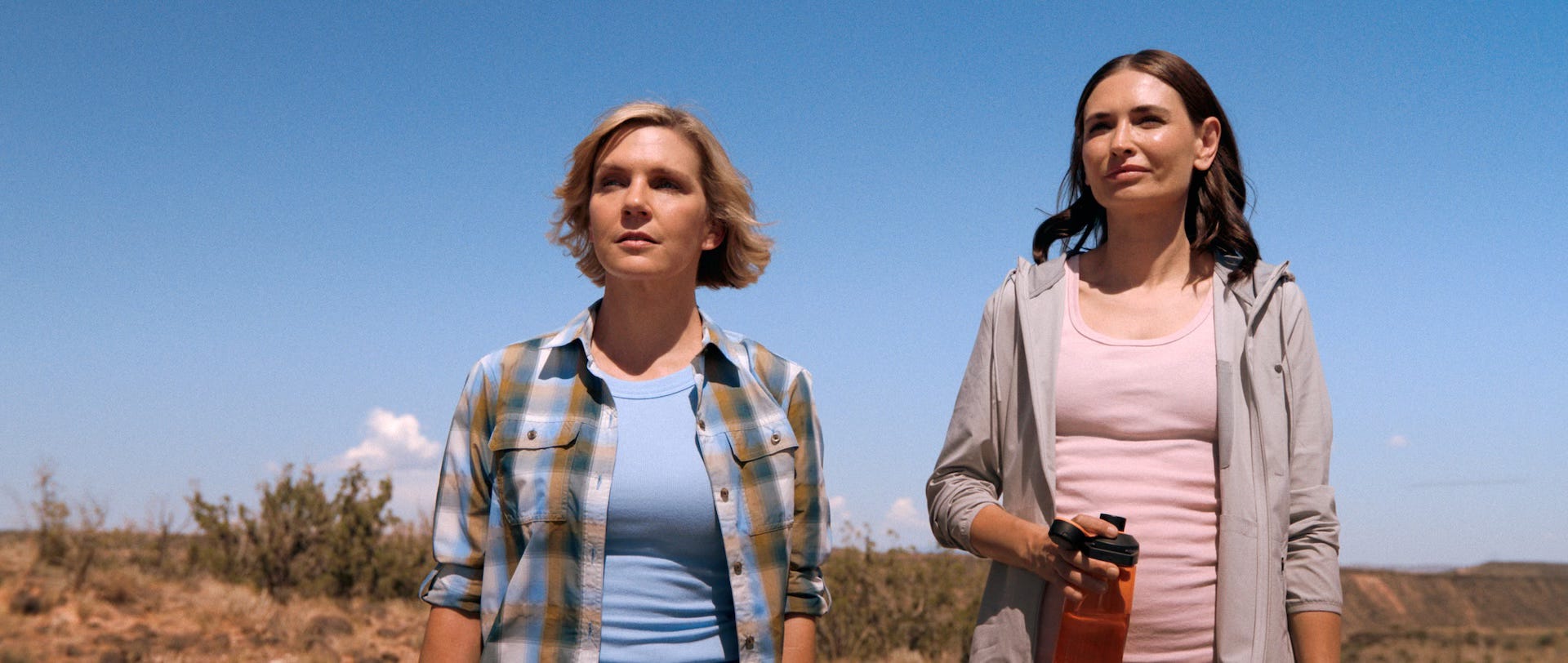
Manousos’ zealotry is too much for either Carol or the hive to bear as he methodically works to understand their function as well as what connection they may have with the frequency at 8613. The hive decides to leave Albuquerque again, and this time Carol goes with them, or at least travels with Zosia. This is where Carol sinks further into the pleasant fiction that the hive provides. While Koumba’s fantasy was one of plenty, Carol’s fantasy is one of almost total isolation. Her heaven on Earth is going to nice, vacant locales with Zosia and spending time together. But this pleasant distraction cannot hold in the face of the truth.
Since the midpoint of the season, Carol has tried to comfort herself with the knowledge that the hive can’t lie. But there are more ways to mislead than simply sharing a falsehood. Even before Carol and Zosia go on their worldwide trip, we can see how Zosia gently attempts to nudge Carol away from her mission. When they see the oncoming arrival of Manousos, Zosia says she can’t be there and “You don’t need to be here when he arrives.” That’s not a lie, but it is a subtle manipulation, using bits of rhetoric and knowledge about Carol to push her to a predetermined direction. We see such manipulation in our own lives, with the vast amounts of data on the Internet going into algorithms and programmatic advertising that doesn’t need to give us the hard sell. It simply nudges us in the direction that those at the controls wish us to go. And were you to confront the tech industry over this behavior, the excuse would be similar to the hive’s: “We just want what’s best for you, and it’s going to make you happier.”
But Carol’s no dummy, and even these quiet machinations can’t last. Carol discovers that the hive is using the stem cells from her frozen eggs to get her to the joining. That was a lie of omission, and it highlights the ways the hive, in all its anodyne pleasantries, can be quite cruel. Just as Zosia told Carol that when it comes to Manousos, “We love him the same as we love you,” they’re also willing to commit sins of omission if it means achieving their “biological imperative.” The prologue with Kusimaya illustrates the lengths the hive will go to get an individual to join them, and also how their affection is phony and flimsy. The second Kusimaya is part of the hive; all of the cultural ceremony and life in the village disappear, and they move on. They have what they want, and there’s no need to continue with culture or even affection for that poor baby goat (I don’t know how that ended up being the most heartbreaking moment of the season, but #JusticeForBabyGoat).
I’m not sure if this makes the hive “evil,” but they’ve shown themselves to be duplicitous, manipulative, and indifferent. They have a way of masking their behavior with calm reasonableness, like with HDP—cannibalism, but hey, at least they would never use violence, right? But not all violence is physical harm, and clandestinely working to deprive an individual of her humanity when she has clearly stated she does not want to be part of the hive is like a lawyer looking for a loophole. “Well, she said she didn’t give her consent to take her stem cells, but if the frozen eggs are already out there…”
Faced with the hard truth that the hive’s affections aren’t real and merely a distraction/sales ploy to get Carol to The Joining, Carol makes her way back to Albuquerque and Manousos. She doesn’t come empty-handed. She also has an atom bomb, a potent symbol of mankind’s capacity for creation and destruction. It’s a technological marvel, and arguably the worst thing humanity ever made. But at least humanity—a collection of individuals of differing beliefs, attitudes, and backgrounds—somehow came together and made it. Carol and Manosuos’ mission to save the world likely won’t be pretty or easy, and if it succeeds, will likely lead to new, unforeseen complications. But at least it will be the work of humans, come what may.
Stray observations:
The prologue was also useful in showing that the hive’s use of stem cells still requires inhaling some kind of mixture. It might be possible that they’ll try to put the compound in Carol’s food or water, but for now, it appears that assimilating Carol is not an immediate threat, although it will hang over Season 2.
I don’t use live-translation software in my daily life, but I guess it can work in airplane mode?
While Seehorn excels at playing the sadness and pain in Carol’s character, what makes her such a fun performer is the way she leans into the jagged edges, which we get in her conversations with Manousos, and I hope we see more of that next season.
The episode’s title, “La Chica o El Mundo,” reminds me a bit of the conflict we saw in The Last of Us, where the tension exists between understanding the needs of the world versus the individual love we feel acutely. Had the hive not been trying to assimilate Carol, perhaps she would have continued in the fantasy where it’s just her and Zosia in the world, living a facsimile of a love story. But Carol’s individual indulgence would have deprived the rest of the world of such individuality. It would be the privatization of love.
That baby goat was your buddy, Kusimaya!
This concludes the first season of Pluribus. All episodes of Season 1 are now streaming on Apple TV. Matt Goldberg is a critic who lives and works in Atlanta. If you enjoyed this review, check out his newsletter, Commentary Track.